Methodology
The STRIDE-AI Framework
The Discipline Behind the Decision.
STRIDE-AI evaluates six organizational conditions that determine whether an AI opportunity can move from idea to sustainable business result. It is the diagnostic and governance engine at the center of every ExIntel engagement.
Assess My Organization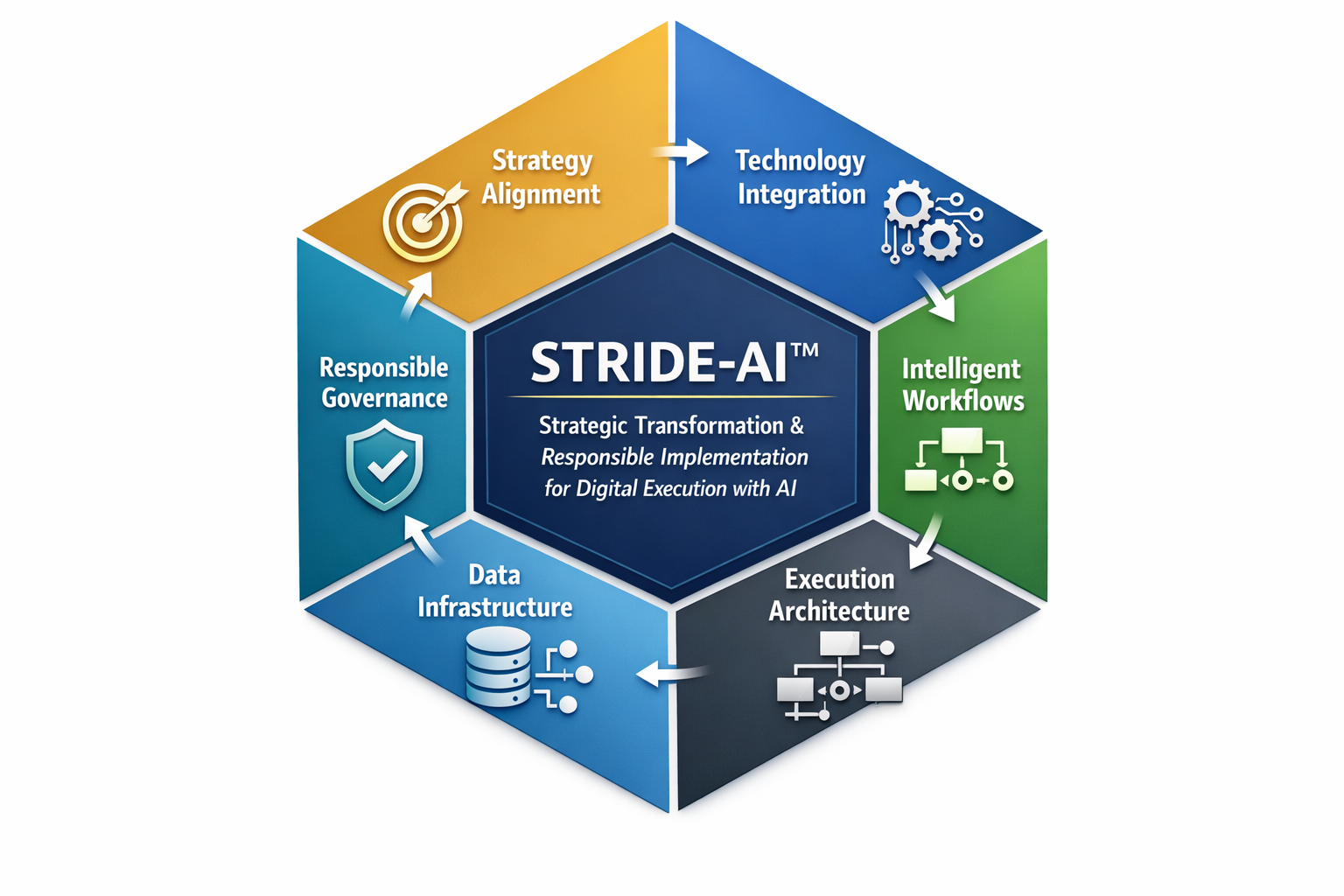
Strategic Transformation & Responsible Implementation for Digital Execution with AI
Strategy Alignment
Connecting AI to Business Purpose
Align AI initiatives with leadership priorities, transformation goals, and enterprise objectives. Ensure every AI investment supports measurable business outcomes.
Key Elements
- Leadership priority alignment
- Strategic roadmap development
- Initiative prioritization
- Value realization framework
Technology Integration
Building the Digital Foundation
Integrate AI tools with enterprise systems, workflows, and digital infrastructure. Create seamless connections between AI capabilities and existing technology investments.
Key Elements
- Enterprise system integration
- API architecture design
- Tool selection guidance
- Infrastructure optimization
Responsible Governance
Ensuring Trust and Accountability
Create oversight, accountability, policy alignment, and risk management structures for AI deployment. Build the governance foundation for sustainable AI adoption.
Key Elements
- Governance framework design
- Policy development
- Risk assessment protocols
- Compliance alignment
Intelligent Workflows
Augmenting Human Performance
Use AI to augment human performance, workflow efficiency, and operational decision-making. Transform how work gets done through intelligent automation.
Key Elements
- Process optimization
- Decision support systems
- Automation strategy
- Human-AI collaboration
Data Infrastructure
Powering AI with Quality Data
Ensure reliable, accessible, governed data systems that support AI effectiveness. Build the data foundation that enables AI to deliver results.
Key Elements
- Data quality assessment
- Governance framework
- Architecture optimization
- Access and security
Execution Architecture
Unifying Transformation Elements
Build the operational system that unifies governance, workflows, data, strategy, and implementation. Create the execution infrastructure for sustainable transformation.
Key Elements
- Operating model design
- Change management
- Performance measurement
- Continuous improvement
Why Execution Architecture Matters
AI does not create transformation by itself. Transformation occurs when strategy, systems, workflows, governance, and data are integrated into a coherent execution model. The STRIDE-AI framework provides this integration.
Assess My Organization